


-
Jaffna
-
Private AC Vehicles
-
English | Italian | Sinhala
The Forgotten Island — Wild Ponies, Dutch Ruins & Ancient Baobabs at Delft
Delft Island — known in Tamil as Neduntheevu, meaning ‘Long Island’ — lies at the southern edge of the Jaffna Archipelago, separated from the mainland by the shallow, turquoise waters of Palk Strait. It is the largest of the archipelago’s islands, but it is a small island by any other measure: roughly 13 km long and 4 km wide, largely flat, swept by wind from every direction, and sparsely inhabited by a community of a few hundred people whose lives are shaped by the sea, the palmyrah palm, and a landscape that has changed very little in centuries.
What makes Delft extraordinary is its collection of improbabilities: things that should not be here but are, each one a thread in a history of human movement across oceans. The wild ponies are perhaps the most remarkable. Descended from horses brought by the Dutch in the 17th century for use in colonial administration, they have roamed freely on the island since the colonial presence ended, adapting to the sparse scrubland, the brackish water, and the wind. Today there are several dozen of them — small, tough, and surprisingly unbothered by human presence — moving across the coral-paved tracks and palmyrah groves in a sight that carries a strange, dreamlike quality.
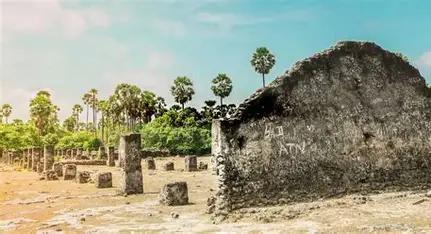
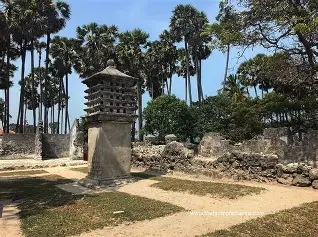
The Dutch fort is a ruin of some drama — its coral stone walls partially collapsed but its footprint clear, standing on the island’s northern shore with the ocean visible through its gaps. The dovecote nearby is an extraordinary survival: a circular tower of stone in which Dutch colonists kept pigeons for communication between the mainland and the island, its interior corbelled walls still bearing the nesting niches used for three centuries.
And then there are the Baobabs: massive, bottle-trunked trees of unmistakably African origin, growing in a cluster on Delft’s northern shore. They were carried here — it is believed — by Arab traders using the island as a waypoint on the Indian Ocean trade routes, centuries before the Dutch or Portuguese arrived. They are the oldest living things on the island, and possibly among the oldest in Sri Lanka. Standing beneath one — a trunk so wide four people cannot link hands around it, branches spreading to catch the wind — is an encounter with deep time.
The journey to Delft is itself part of the experience: a ferry from Punkudutivu across shallow water so clear you can see the sandy bottom, through a sea scattered with small islands and the silhouettes of fishing catamarans on the horizon.
Highlights:
- Cross by ferry through the shallow, glittering Jaffna Lagoon to the remote island of Delft
- Encounter wild ponies descended from Dutch colonial horses — roaming freely across white coral roads
- Explore the atmospheric ruins of the 17th-century Dutch fort and the colonial-era stone dovecote
- See giant Baobab trees — African giants carried to Delft by Arab traders centuries before Dutch arrival